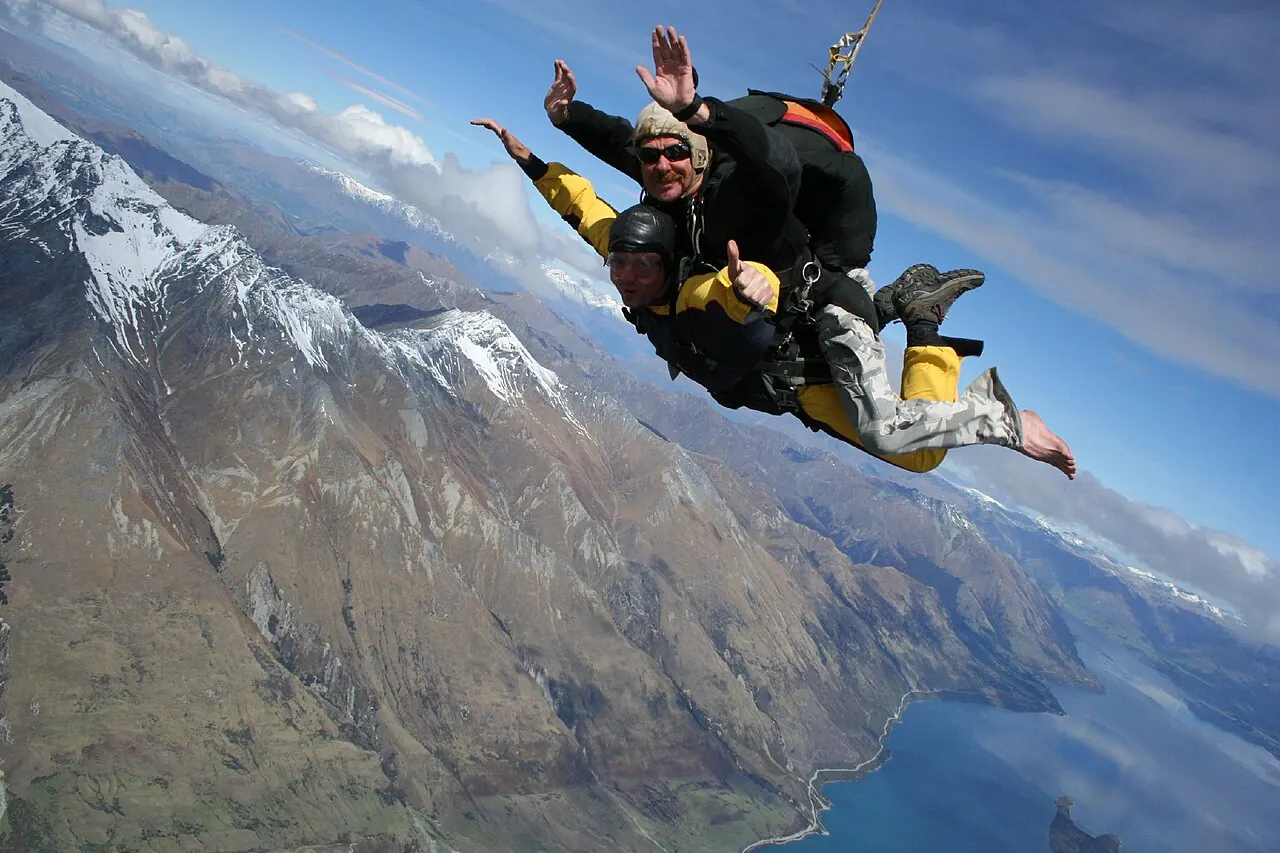
Tandem jumps cost NZ$379 from 9,000 ft to NZ$575 from 15,000 ft, where freefall lasts up to 60 seconds. NZONE lands on a private airstrip at the foot of the Remarkables and suggests jumping early in your stay.
Updated October 22, 20262 operators comparedPrices in NZ dollars8 sources
From each operator's own website, checked October 22, 2026. How we compare.
35 Shotover Street to the Remarkables airstrip
Every NZONE jump starts at the NZONE Skydive Centre, 35 Shotover Street, in central Queenstown. You check in, register and watch a video briefing in its cinema room. A bus then takes about 20 minutes to reach the drop zone, a private airstrip on a working sheep farm at the foot of the Remarkables. Return transport is included. Driving yourself to the drop zone is allowed, but you still have to check in at the town centre first.
The plane climbs over the Wakatipu basin, and jumpers leave it above the drop zone. Down on the airstrip, a viewing area has drinks, snacks, toilets, a gift shop and lockers. Bus seats are guaranteed only to the people jumping. Children can ride along if they can wear a seatbelt and a seat is free, but New Zealand law keeps infants and baby carriers off the buses.
60 seconds of freefall from 15,000 ft
NZONE lists up to 25 seconds of freefall from 9,000 ft, 45 seconds from 12,000 ft and 60 seconds from 15,000 ft, all at about 200 km/h. The climb takes 15 to 20 minutes in one of its two Cessna Grand Caravans, which it calls Supervan 900s. Each plane carries up to 9 customers, so friends may be able to fly together, and NZONE claims the biggest plane capacity in the country.
After the Tandem Master opens the parachute, the canopy ride lasts 3 to 4 minutes according to NZONE's price page, or 4 to 5 minutes according to its Queenstown page. The company puts the whole outing at about 3.5 hours from check-in to return, which can run longer if weather or air traffic causes a hold. Its Queenstown page says to allow 3 hours.
Weather holds and the 40 kg minimum
Jumps depend on the weather. If it stops yours, NZONE tries to move you to the next suitable slot, and it refunds you in full to the original payment method if that is not possible. It advises booking the first free slot of your trip and keeping a spare day, and it recommends morning jumps for the views over Queenstown. NZONE flies seven days a week throughout the day.
Children can be assessed from age 6 if they are at least 1.2 m tall, weigh 40 kg or more and fit the harness, and those 12 and under jump only from 9,000 ft. Under-18s need written consent from a parent or guardian. There is no upper age limit; NZONE says passengers up to 94 have jumped. Every jumper must weigh at least 40 kg, and anyone 95 kg or heavier is assessed by a Tandem Master at the drop zone.
Tell NZONE before booking about epilepsy, high blood pressure, angina or any heart condition, and about recent injuries, surgery or mobility limits; a doctor's letter may be required. Jumping with a cold, the flu or blocked sinuses can cause trouble in the air or afterwards, NZONE warns. People with a history of shoulder dislocation can still jump, using a different body position in freefall.
9,000, 12,000 or 15,000 ft with NZONE
NZONE is the only skydive operator listed here, since Skydive Southern Alps and Skydive Paradise showed no usable trip details online when checked on October 21, 2026. A 9,000 ft jump is NZ$379, 12,000 ft NZ$469 and 15,000 ft NZ$575, with return transport from town included. Photo and video cost extra: NZ$220 for the Handicam package, NZ$333 for Freefall and NZ$395 for the Ultimate Combo, and the last two are arranged only on the day. Cards carry a 1.2% surcharge at the drop zone and over the phone, though New Zealand Eftpos cards are exempt.
NZONE calls itself New Zealand's first tandem skydive operation and says it has run for more than 30 years and flown over 350,000 tandem jumps. Personal cameras of any kind, GoPros and smart glasses included, are banned on the jump under an NZPIA safety requirement, though photos on the ground beforehand are fine. NZONE sells no life insurance. ACC covers medical treatment in New Zealand, and the company suggests asking your travel insurer whether it covers tandem skydiving.
Before you book
Wear sturdy shoes that will not come off, ideally enclosed lace-ups, and in winter several thin layers rather than one bulky jacket. NZONE supplies a jumpsuit, gloves, hat and goggles, and the goggles fit over glasses.
Spectators can ride the NZONE bus free when there is room, one per customer and not on the last run of the day, or drive themselves to the drop zone.
Tell staff at check-in if you get motion sickness; sick bags are on board and your instructor will help. Contact lens wearers should bring solution in case their lenses dry out.
WorkSafe lists skydiving as adventure aviation regulated by the Civil Aviation Authority and almost certainly outside its adventure activities regulations, so look for CAA certification rather than an entry on WorkSafe's register.